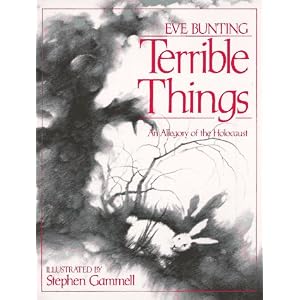
The first picture book we will be reading is Terrible Things: An Allegory of the Holocaust by Eve Bunting. Here are a few important terms and background to consider before reading the book:
1. The Holocaust: systematic persecution of approximately 6 million Jews by the Nazi Regime
Timeline of Holocaust and World War II
2. Martin Niemöller (1892-1984) was an ardent nationalist and prominent Protestant pastor who emerged as an outspoken public foe of Adolf Hitler and spent the last 7 years of Nazi rule in concentration camps.
Niemöller is perhaps best remembered for the quotation:
First they came for the Socialists, and I did not speak out --
Because I was not a Socialist.
Because I was not a Socialist.
Then they came for the Trade Unionists, and I did not speak out --
Because I was not a Trade Unionist.
Because I was not a Trade Unionist.
Then they came for the Jews, and I did not speak out --
Because I was not a Jew.
Because I was not a Jew.
Then they came for me -- and there was no one left to speak for me.
3. Terms to know:
Allegory: a text (poem, story, novel, painting, etc.) that symbolizes a universal idea; Terrible Things is an allegory of the Holocaust because characters and the plot symbolizes actual events and problems of this historical event.
Community: a group of people living in the same location
Responsibility: something you are accountable for
Perpetrator: someone who is guilty or responsible for something
Victim:one who is harmed or killed as if by accident, disease, or intention
Bystander: one who is present at an event without participating
Upstander: someone who takes action on behalf of others
Analyze and write in your notebook:
1. Title and author 2. Social issues and messages 3. Genre and author's purpose 4. Style and craft
Post-reading Questions:
- How is this an allegory of the Holocaust? What does it show about this historical time period?
- Look back at the terms. Who are the victims? The perpetrators? The bystanders? The upstanders? What does the text show about them?
- What are the messages in this book? How can they be applied to your life and life in general?
- How does the book relate to the Universe of Responsibility activity we did? What conclusions can you make based on the activity and the text?
Full Text:
No comments:
Post a Comment